Artificial intelligence has become the backbone of modern digital transformation. Among the most prominent advancements are large language models (LLMs), designed to understand, generate, and interact with human language at an unprecedented level. With GPT-5 officially entering discussions across the tech landscape, many businesses, creators, and researchers are comparing it with other AI models to understand its strengths, weaknesses, and practical applications.
In this article, we’ll take a comprehensive look at GPT-5 vs other AI models, focusing on accuracy, speed, scalability, and unique capabilities. By the end, you’ll have a clear understanding of where GPT-5 stands in the increasingly competitive world of artificial intelligence.
The Rise of GPT-5: A Quick Overview
OpenAI’s GPT series has consistently set new benchmarks in the large language model industry. GPT-5 builds on its predecessor (GPT-4) with improvements in reasoning ability, contextual memory, multimodality, and efficiency. Unlike earlier versions limited largely to text input and output, GPT-5 integrates advancements in image, audio, and video understanding, enabling more natural multimodal interactions.
Key highlights of GPT-5 include:
- Improved Contextual Memory: Handles larger conversations without losing track of details.
- Faster Inference: Generates responses more quickly and with fewer computational overheads.
- Greater Accuracy: Produces fewer factual and logical errors compared to GPT-4.
- Enhanced Multimodality: Stronger handling of text plus images, audio, and potentially video.
- Generalized Knowledge: Broader and deeper training data for niche industries.
These upgrades position GPT-5 as a leading model not just for conversational AI but also for complex reasoning, enterprise tools, and creative applications.
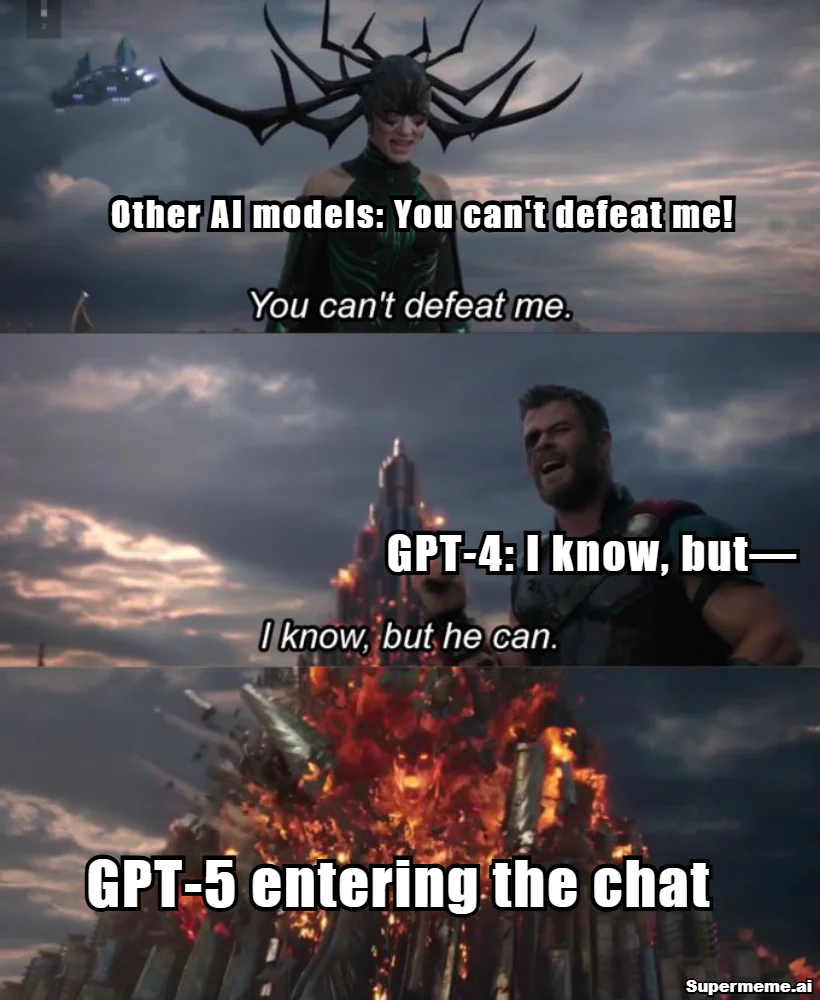
GPT-5 vs Other AI Models: Key Comparisons
When assessing GPT-5 vs other AI models, it’s crucial to evaluate across three dimensions: accuracy, speed, and capabilities. Let’s see how GPT-5 measures against competitors such as Google’s Gemini, Anthropic’s Claude 3, and Meta’s LLaMA 3.
1. Accuracy: Which AI Gets It Right More Often?
Accuracy is one of the most valuable metrics when comparing large language models, especially for professional applications where errors can have significant consequences.
- GPT-5
GPT-5 builds on GPT-4’s reasoning and fact-checking abilities, showing major improvements in instruction following and domain-specific accuracy. It makes fewer hallucinations and demonstrates more reliable reasoning in technical fields like programming, healthcare guidance, and financial analysis. - Claude 3 (Anthropic)
Claude models are known for their safety emphasis, with strict alignment to reduce harmful or misleading outputs. Claude 3 often excels in logical consistency and ethical considerations, though it sometimes sacrifices generative creativity for caution. - Google Gemini
Gemini integrates AI with Google’s search ecosystem, helping it retrieve up-to-date factual data with higher reliability. This gives Gemini an advantage in real-time information accuracy, though it sometimes lags behind GPT-5 in natural creativity and nuanced narrative structures. - Meta’s LLaMA 3
LLaMA models are optimized for research and open-source AI flexibility. While strong for academic use and certain reasoning frameworks, they tend to produce less polished outputs compared to GPT-5 and Gemini.
Verdict on Accuracy:
GPT-5 leads in accuracy for complex reasoning tasks, Gemini performs best in real-time factual grounding, and Claude prioritizes safe and ethical alignment.
2. Speed: Performance and Responsiveness
For enterprise deployment—chatbots, real-time assistants, automated workflows—the speed of inference is a deciding factor.
- GPT-5
GPT-5 is reported to have improved latency reduction compared to GPT-4, making it more efficient for high-volume applications. Its architecture optimizes both single-shot queries and long-context processing. - Claude 3
Known for responsiveness in handling large document inputs, Claude can quickly process long-context prompts, especially in legal and compliance industries. Its speed is competitive but varies based on input complexity. - Gemini
Gemini leverages Google’s TPU-based infrastructure, providing lightning-fast responses, especially in integrated Google tools like Gmail, Docs, and Search. - LLaMA 3
LLaMA is highly efficient in smaller-scale applications due to its lightweight architecture. Enterprises adopting open-source deployment often find LLaMA faster on localized servers, though less powerful for massive-scale queries.
Verdict on Speed:
Gemini has the fastest real-time response due to Google’s infrastructure. GPT-5 balances speed and accuracy well, while LLaMA 3 is excellent for lightweight, self-hosted solutions.
3. Capabilities: Beyond Basic Chatting
While speed and accuracy matter, the capabilities of an AI model define its long-term usability.
- GPT-5
- Multimodality: Processes and understands text, images, audio, and potential video.
- Memory: Maintains dynamic contextual memory, enabling continuity over days or weeks of interaction.
- Advanced Creativity: Stronger at long-form writing, storytelling, coding, and strategies.
- Industry Flexibility: Useful across entertainment (scriptwriting), business (financial forecasting), and education (tutoring).
- Claude 3
- Focus on constitutional AI principles for ethical outputs.
- Excels at summarizing large documents and performing safe reasoning.
- More cautious in creative tasks, often producing "guarded" responses.
- Gemini
- Deep integration with Google Workspace.
- Powerful web-connected knowledge retrieval.
- Strong multimodal skills, especially visual inputs like chart understanding — highlighting the edge in GPT-5 vs Google Gemini.
- LLaMA 3
- Designed for open-source adaptability and model fine-tuning.
- Less advanced in multimodal reasoning, but strong for AI research communities.
- Ideal for companies that want customizable, secure local deployment.
Verdict on Capabilities:
GPT-5 is the most versatile all-rounder in terms of multimodality and contextual depth. Gemini shines in search-driven augmentation, Claude in ethical safety, and LLaMA in decentralized flexibility.

Industry Applications: GPT-5 and Competitors
Let’s see how GPT-5 vs other AI models play out across different industries.
- Content Creation & SEO
- GPT-5 generates creative, SEO-optimized content with coherent long-form structures.
- Gemini excels in integrating real-time keyword data from search trends.
- Claude helps ensure content remains ethically aligned, reducing risks.
- LLaMA offers tailored SEO tools when fine-tuned on custom datasets.
- Healthcare & Legal
- GPT-5’s reasoning accuracy makes it valuable for summarizing diagnostics and analyzing legal contracts.
- Claude’s ethical safety makes it reliable for sensitive information.
- Gemini provides up-to-date real-world references but is limited by cautionary filters.
- Business & Finance
- GPT-5 predicts trends and creates strategic projections with strong analytical depth.
- Gemini connects directly to real-time market data.
- Claude helps with compliance checks and audits.
- LLaMA serves enterprises seeking private AI without third-party hosting.
- Creative Industries
- GPT-5 is superior for screenwriting, brainstorming, and design ideation.
- Claude offers structured creativity while remaining ethically balanced.
- Gemini integrates visual creativity (chart or design recognition).
- LLaMA’s creativity depends heavily on fine-tuning.

Strengths and Weaknesses of GPT-5
Like any AI model, GPT-5 has both outstanding strengths and areas where competitors may have an edge.
Strengths:
- Superior logical reasoning and contextual memory.
- Balanced accuracy and speed, optimal for real-world use.
- Advanced multimodality, making it future-proof.
- Strong creative writing and ideation.
Weaknesses:
- Not as closely tied to real-time internet data as Gemini.
- Less customizable than open-source LLaMA models.
- Ethical safety measures may not be as strict as Claude’s framework.
The Future of AI: Will GPT-5 Stay Ahead?
The debate around GPT-5 vs other AI models ultimately underscores how different models serve unique purposes. GPT-5 may dominate in generalized flexibility, but specialized users may lean toward Gemini for real-time insights, Claude for safe and ethics-driven decisions, or LLaMA for open-source independence.
Looking ahead, the competition will shift toward:
- Smarter multimodal reasoning (seamless text + video/audio).
- Personalized AI memory for individuals and businesses.
- Hybrid AI solutions combining open-source and proprietary strengths.
- Ethical AI governance, ensuring safety across industries.

Final Thoughts
When examining GPT-5 vs other AI models, the decision depends on your priorities:
- Choose GPT-5 if you’re looking for the most balanced mix of creativity, reasoning, and multimodal capability.
- Choose Gemini if real-time, data-driven accuracy is your top priority.
- Choose Claude if your industry requires strict safety and ethical outputs.
- Choose LLaMA if you need customizable, open-source deployments for privacy and control.
Ultimately, GPT-5 positions itself as the most versatile all-in-one model, evolving beyond text generation into a multi-industry powerhouse. Its improvements in accuracy, speed, and capabilities allow it to lead the AI race, but the future will likely be a coexistence of multiple AI models, each excelling in different domains.