Gartner's research reveals that over 60% of companies identify internal process inefficiencies as the actual culprit behind competitive losses. Business process optimization tackles this directly — it's essentially a structured review of how work actually gets done, with a focus on extracting maximum value from every resource committed.
This article navigates practical strategies, concrete tools, and deployment approaches that have produced demonstrable improvements across different industry contexts.
Technology Landscape: What's Changing the Game

The market for business process optimization tools is experiencing a genuine boom. IDC forecasts that spending on automation technologies will reach $232 billion by 2025. Many organizations turn to specialized providers, where professional business process services help structure the approach to change and avoid common mistakes during transformation. Let's examine key directions.
Robotic Process Automation (RPA)
UiPath, Automation Anywhere, and Blue Prism lead the RPA segment. The technology allows automating repetitive tasks without changing existing systems. Deloitte implemented RPA in its finance department, cutting invoice processing time from three days to four hours.
An interesting case — Deutsche Bank. The bank deployed over 500 software robots processing approximately 5 million transactions monthly. Savings totaled €1 billion over three years. RPA technology proves especially effective for processes with clear rules: order processing, data reconciliation, report generation.
Process Mining
Celonis, UiPath Process Mining, and Signavio allow visualizing actual processes based on data from enterprise systems. BMW uses process mining to analyze production processes at factories in 30 countries. The system identified bottlenecks in the supply chain, allowing a 20% reduction in equipment downtime.
The technology works with event logs — records of events in ERP, CRM, and other systems. Algorithms recreate the actual flow of processes, detect deviations from standards, and calculate improvement potential. Vodafone applied process mining to optimize customer service processes, reducing average request handling time from 11 to 7 days.
Low-Code/No-Code Platforms
Mendix, OutSystems, and Microsoft Power Platform democratize application development. Employees without deep technical knowledge can create solutions for process automation. Schneider Electric developed 150+ applications in a year using a low-code platform, whereas previously the IT department created 15-20 applications annually.
This approach reduces dependence on IT departments and accelerates implementation of changes. However, questions arise regarding governance and security — organizations need clear policies for using such platforms.
Artificial Intelligence and Machine Learning

AI changes approaches to decision-making in business processes. Unilever uses AI for resume screening and initial interviews, processing 1.8 million applications yearly. The system analyzes video interviews, evaluating candidates' soft skills. This cut hiring time by 75% and reduced selection bias.
JPMorgan Chase implemented the COiN (Contract Intelligence) system, which analyzes legal documents. Work that previously required lawyers to spend 360,000 hours annually now takes seconds. The system recognizes patterns in commercial loan agreements and identifies potential risks.
Business Process Optimization Strategy: Building a Systematic Approach

Chaotic point improvements rarely produce lasting effects. A holistic strategy is needed that unites people, processes, and technologies.
Diagnosis and Process Mapping
The first step is to understand how processes actually work, not how they're described in documents. BPMN (Business Process Model and Notation) has become the standard for process visualization. Tools like Bizagi, Lucidchart, or Microsoft Visio help create detailed maps.
It's critically important to involve people who directly perform the work. They know the real problems, workarounds, and non-obvious dependencies between stages. Nestlé conducted workshops with 200+ employees to map supply chain processes, identifying 47 duplicate activities between departments.
Value Stream Mapping — a technique from Lean manufacturing that works well for process analysis. The method focuses on activities that create value for the customer and identifies waste: waiting, unnecessary movement, excess processing, defects.
Initiative Prioritization
Not all processes require immediate optimization. The Impact-Effort matrix helps determine priorities. Processes with high impact and low effort for improvement — quick wins that deliver fast results and motivate the team.
General Electric applies Six Sigma methodology for prioritization. Projects are evaluated by quality improvement potential (reducing defects to 3.4 per million opportunities) and financial impact. The company realizes 500+ optimization projects annually, ensuring billion-dollar savings.
How to Optimize Business Processes: Practical Implementation Steps
Theory without practice remains just pretty slides in presentations. Let's examine specific approaches to implementing changes.
Automating Routine Operations
The Pareto rule applies here too: 20% of processes create 80% of time costs. Identify high-frequency repetitive tasks with clear logic. These are the best candidates for automation.
Maersk, the world's largest shipping company, automated logistics documentation. Previously, one container shipment generated up to 200 paper documents passing through 30+ parties. Implementation of the TradeLens blockchain platform with IBM cut document processing time from weeks to hours. The platform now processes 1+ billion events annually.
Standardization and Eliminating Variability
When one process is performed ten different ways, talking about efficiency becomes difficult. McDonald's built an empire on standardization — a burger in London is prepared the same way as in Tokyo. This principle works in the corporate environment too.
Spotify implemented the "squads" concept — small autonomous teams with clear interaction processes. Standardized rituals (sprint planning, retrospectives, demos) ensure predictability and development speed. The company releases new features dozens of times daily, maintaining service quality for 500+ million users.
Eliminating Bottlenecks
Eliyahu Goldratt's Theory of Constraints states: system productivity is determined by the weakest link. Identifying and expanding bottlenecks produces maximum effect.
Toyota applies Kanban to visualize work flow and identify bottlenecks. When tasks accumulate at a certain stage, it signals a problem. Netflix adapted this approach for software development. Teams monitor flow metrics: time in each status, number of tasks in progress simultaneously (WIP limits), task movement speed.
Technology Tools for Different Optimization Stages
Tool selection depends on process specifics, organizational technological maturity, and budget.
Automation Platforms
UiPath offers enterprise-grade RPA with AI capabilities. Coca-Cola automated 60+ processes in the finance department, processing 1.5 million transactions monthly.
Zapier — a no-code solution for integrating cloud applications. Suitable for SMBs and startups. Over 5 million users automate processes without involving developers.
Kissflow — a low-code BPM platform. Freshworks uses Kissflow to manage HR processes, from onboarding to performance reviews.
Collaboration and Change Management Tools

Miro and Mural — virtual boards for process mapping workshops. Cisco conducts global optimization sessions, involving teams from different continents.
Monday.com and Asana — project management tools for coordinating optimization initiatives. Transparent roadmaps and automated notifications keep stakeholders informed of progress.
Slack with workflow builder allows creating simple automations without code. Spotify uses Slack workflows to standardize communication processes between 200+ teams.
Challenges and How to Overcome Them
Technology is only part of the equation. Most obstacles have a human nature.
Resistance to Change
Employees fear automation, seeing threats to jobs. AT&T invested $1 billion in a reskilling program, training 100,000+ workers in new skills. Instead of layoffs, the company retrains people to work with new technologies.
Communication is critical. Siemens holds town hall meetings where leaders explain reasons for changes and demonstrate benefits. Involving employees in improvement design processes reduces resistance — people support what they help create.
Unrealistic AI Expectations

Vendor marketing promises magical results from AI. Reality is more complex. Algorithms require quality data, configuration, constant monitoring. IBM Watson Health, despite loud promises to revolutionize medicine, faced implementation problems and was sold in 2022.
Start with simple use cases, demonstrate value, scale successful solutions. Google recommends a "crawl, walk, run" approach to AI implementation.
Lack of Proper Expertise
Process optimization requires multidisciplinary skills: understanding business, technology, change management, data analytics. Organizations invest in developing internal capabilities or engage external experts.
Accenture, Deloitte, and KPMG offer business transformation consulting. For companies needing operational support rather than consulting, managed services exist where partners take over execution of optimized processes.
Measuring Results and Continuous Improvement
ROI from process optimization must be transparent and measurable.
Financial Metrics
Cost savings — the most obvious metric. Bank of America saved $2 billion annually through automation and process optimization in retail banking.
Revenue impact — sales or customer service process optimization affects income. Amazon attributes 35% of its revenue to its recommendation engine — an optimized personalization proposal process.
Avoidance costs — expenses avoided. Compliance process automation reduces fine risk. GDPR violations cost companies up to €20 million or 4% of global revenue.
Operational Metrics
Process cycle time reduction — cutting processing time. Visa processes 65,000 transactions per second thanks to optimized infrastructure and processes.
Quality improvements — reducing error rates. Toyota achieved legendary quality levels (3.4 defects per million) through decades of production process optimization.
Employee productivity — freeing employee time from routine. Deloitte calculated that RPA increases productivity by 50-70% for automated processes.
The Future of Process Optimization
Technology trends are shaping the next generation of efficiency approaches.
Hyperautomation
Gartner identified hyperautomation as a top trend. This is a combination of RPA, AI, machine learning, and process mining into a unified ecosystem. Organizations automate not individual tasks but entire end-to-end processes.
Collaborative Robots in Physical Processes
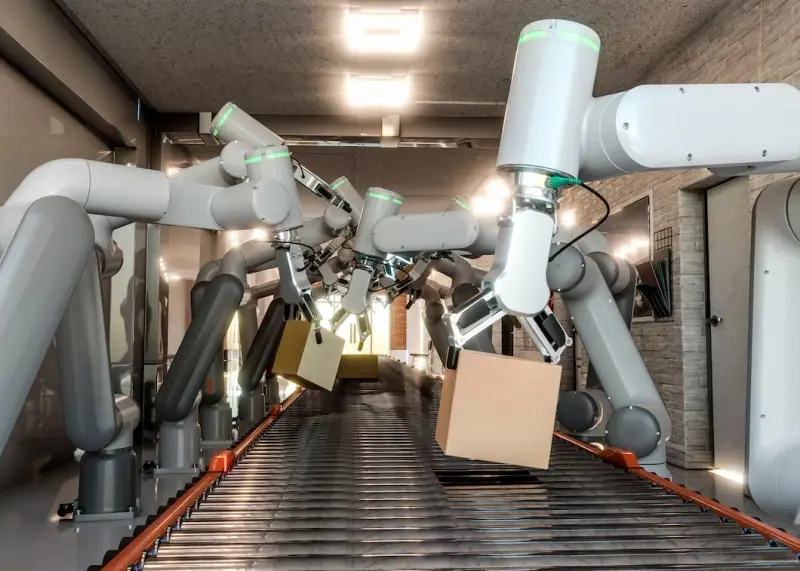
Cobots — robots that work alongside humans. BMW uses cobots at factories for ergonomically difficult operations. The robot holds heavy parts, the person performs precise work. Productivity increased by 85%, injuries decreased by 50%.
Process Intelligence
The next step after process mining — predictive and prescriptive analytics. Systems not only show what's happening but also predict problems and recommend actions. Celonis Process Sphere uses AI to identify optimal improvement options and calculate their impact.
Conclusions
Business process optimization stopped being a discretionary project somewhere around 2015. Today it's infrastructure — as essential as accounting systems or basic IT security.
Start by honestly mapping existing processes and identifying where the biggest friction lives. Set targets that people can actually track and understand. Bring the people who execute the work into the design phase — they see inefficiencies managers miss. Run experiments with tools and approaches before full deployment. Track what changes and measure it against the baseline you established.
McKinsey's data on comprehensive process transformation programs shows a median ROI of 200-300% across a three-year period — compelling numbers, yet they disguise the actual mechanics. These returns don't materialize through technology deployment alone. They emerge from sustained effort, decision-making discipline, and genuine organizational readiness to operate differently. The tools are enablers. Strategy provides direction. People execute the reality. Without alignment across all three dimensions, even the most sophisticated software generates expensive frustration rather than results.